
Accounts Receivable Balance is a key business indicator because it reflects liquidity, cash flow, and the effectiveness of customer credit management. If a business has too many accounts receivable, it may signal problems collecting payments, while if it's too low, it could indicate sales limitations or missed opportunities. Let's explore what your Accounts Receivable Balance can tell you about your business
What is Accounts Receivable Balance?
Accounts Receivable Balance refers to the total amount of accounts receivable that a business has not yet received from customers at a given time, resulting from sales of goods and services made on credit. Accounts receivable are recorded as a current asset in a company's financial statements because they represent funds expected to be received in the future.
The Accounts Receivable Balance reflects a business's financial liquidity. A high outstanding balance may indicate difficulties in debt collection or that credit extensions are too risky, potentially impacting the company's cash flow. Conversely, a low accounts receivable balance may suggest a business has an overly strict credit policy, leading to missed sales opportunities.
How to calculate Accounts Receivable Balance
The total amount a company expects to receive from unpaid accounts receivable measures its liquidity and efficiency in managing accounts receivable. It is calculated as the sum of the Aging of Accounts Receivable
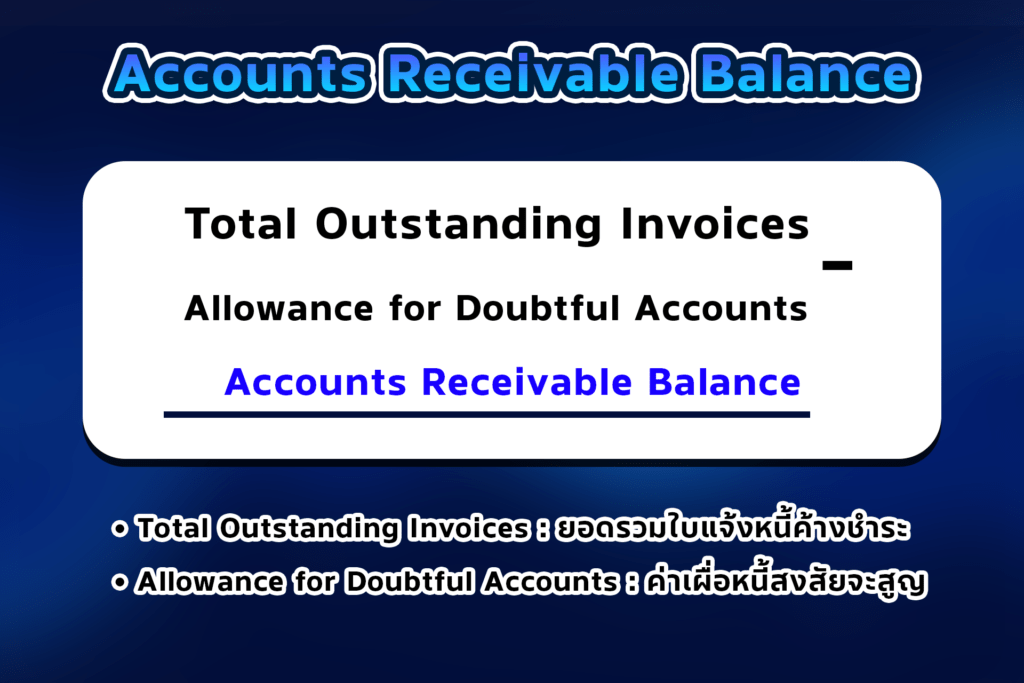
- Total Outstanding Invoices refers to the total amount of invoices that have not yet been paid by customers or business partners. This is the amount the business still owes according to the agreed payment terms.
- Allowance for Doubtful Accounts refers to the provision for potential unpaid debts. This is an accounting reserve set aside to cover the risk of debtors defaulting on payments.
example
If a company has issued invoices totaling 100,000 baht and expects that 5,000 baht may be uncollectible (provision for doubtful accounts), the outstanding accounts receivable balance will be:
Accounts receivable balance = 100,000 baht - 5,000 baht = 95,000 baht, or use the sum of outstanding balances
- Aging of Accounts Receivable: This report shows the amount of money owed by customers over a period of time, such as 30 days, 60 days, or 90 days. It is used to assess and analyze unpaid invoices, including the length of time those invoices have been outstanding.
Example of an outstanding balance table based on an invoice.
| Age categories | The amount on the invoice | Total |
| 0-30 days | 100,000 | 100,000 baht |
| 31-60 days | 50,000 | 50,000 baht |
| 61-90 days | – | 0 baht |
| More than 90 days | 25,000 + 10,000 | 35,000 baht |
AR Balance = 100,000 + 50,000 + 0 + 35,000 = 185,000 Baht
How to read
An increasing trend: If the accounts receivable balance continues to rise, it may indicate that the company is selling more goods/services or that it may be having difficulty collecting payments.
A decreasing trend: If the accounts receivable balance decreases, it may indicate improvements in collections or a decrease in sales.
The Importance of Accounts Receivable Balance
Show unpaid income
This is the amount of money a business expects to receive from customers; it is revenue that has been generated but not yet received in cash
Reflecting the business's liquidity
If accounts receivable are too high, it may indicate problems collecting cash, which affects the business's cash flow. Conversely,
if accounts receivable are low, it may mean good customer credit management, or it could be a sign of declining sales.
Please analyze the credit risk
If trade receivables are in arrears for an extended period, it may signal that the customer is experiencing financial difficulties and could negatively impact the business
This information is used for financial statement analysis
This has an impact on financial ratios, such as the Accounts Receivable Turnover Ratio , which is used to measure the efficiency of debt collection.
This affects working capital management
Effectively tracking and managing accounts receivable helps businesses maintain sufficient cash for ongoing operations and investments
You can find other articles at: https://demo.rdbi.co.th/blog/
For inquiries or information regarding Accounts Receivable Turnover, please contact us
Page: http://bit.ly/rdbipage
Facebook : https://www.facebook.com/RandDBI/
Line OA : @rdbi
Tel : 02-681-9700
Email : sales@rdbi.co.th 🌟