
Business decision-making is crucial for achieving success and growth.
Sharp, data-driven decisions, coupled with the confidence and assurance of business owners or managers, can drive business growth and success in a highly competitive industry.
Business and decision-making are always intertwined, and business people are constantly making decisions
- How can you sell better? You have to make a decision
- Should I add more products? Where should I sell them? Who should I sell to next? These are the decisions I need to make
- How do you create a workflow that avoids bottlenecks and ensures smooth workflow? It requires making decisions
- How to set up the system? That's a decision
In the daily operation of a business, decisions are inevitable; there are always issues to decide on. If owners and managers make sharp decisions, it will help the business grow and progress. Conversely, indecision will hinder growth and may cause the business to stagnate
"Decision-making is therefore a key indicator of success or failure, especially when it comes to important decisions."
A way of thinking that will help you make sharper decisions
Some people make excellent decisions, while others consistently make mistakes. Outwardly, it seems like a matter of luck, but in reality, making good decisions involves a process that helps refine judgment
Shane Parrish, a former intelligence officer who faced crucial life-changing decisions, identified a root cause of poor decision-making as a lack of sharp thinking. In his book, "Clear Thinking," he suggests six steps to sharpen thinking and improve decision-making
He stated that the reason our thinking is not sharp stems from human nature, including unconscious emotional responses that prevent careful consideration, and our ego. Furthermore, humans crave social acceptance, leading them to conform and avoid appearing different, resulting in thoughts, beliefs, and outcomes similar to others. Finally, fear of change prevents decisive action due to an unwillingness to adapt
To minimize the negative impacts of decision-making and to enable us to make sharper decisions, we should take breaks to reflect before making a decision. We should use reason instead of automatic reactions, cultivating a thought process that will help us make better decisions in various matters
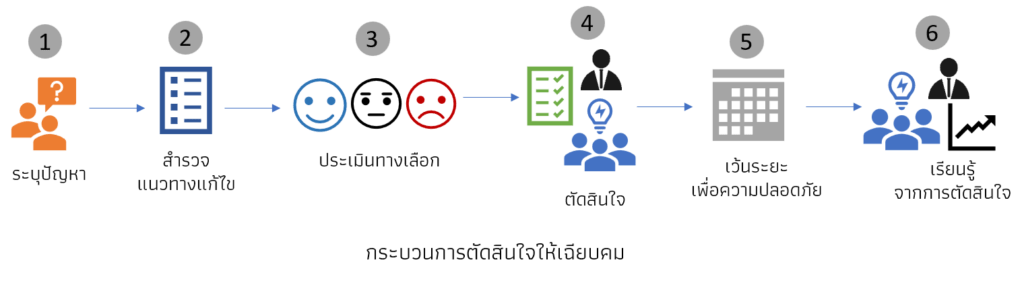
The decision-making process consists of six steps:
- Identify the problem
- Explore possible solutions
- Evaluate the options
- decide
- Maintain a safe distance
- Learn from your decisions
1. Identify the problem
First, clearly understand what the real problem is. Don't resort to short-term solutions without considering the underlying causes. Therefore, give yourself time. If you can't see the cause of the problem at first, ask yourself: What could have prevented this problem from happening in the first place? This will help you identify the root cause. This perspective will allow you to see the source of the problem and subsequently find a solution. For example..
"When sales drop," people try to boost them by lowering prices or running promotions
The problem may not be with the price, but rather with the quality or features of the product that don't meet customer needs
Or customers might switch to other channels that offer home delivery services, but our business and our products don't do that yet
2. Explore possible solutions
From the example above regarding the problem of declining product sales, the most common approach to solving it is like this:
1) Run promotions with discounts, exchanges, and giveaways, or
2) Stop selling and focus on developing higher-quality products that meet customer needs.
The first option focuses on solving the problem in the short term.
Another option is to go back to the root cause of the problem, developing the product while simultaneously running promotions to allow people to try it out and collect feedback to further improve the product
Therefore, we should always collect data and create additional options to prepare for the future
Explore multiple possible solutions, for example, to address the problem of declining product sales
– Adding new, higher-quality products to meet the needs of customers who demand quality and can therefore be sold at higher prices
– If customers don't require high quality, reduce the product's features, make the price reasonable, and offer good value
Because the needs of each customer group are different
In addition to adding new products, another solution is to expand sales channels for existing products. Instead of selling in department stores or branches, add online sales on platforms like Lazada, Shopee, and TikTok, as well as selling on the company website and using private courier services. Collect sales data from each channel to understand who your customers are on each platform. Conduct in-depth customer analysis for each channel to gain insights into customer behavior across all sales channels
3. Evaluate the alternatives
After exploring alternative solutions, evaluate each option by examining its advantages and disadvantages, costs, speed of implementation, the number of employees required, and the timeframe to see results. Consider the opportunity cost, the percentage of success, and the return on investment for each option. Compare all options
From the example above, we need to evaluate which option is the most suitable, the fastest, the least expensive, and has the highest probability of success
4. Make a decision
“Once the information is available and the options have been evaluated, a decision should be made to achieve the desired outcome“
Some people may hesitate to make decisions. Why? Are they afraid of making the wrong decision?
Conversely, some people make decisions immediately, even when they are not ready.
To determine if you are ready, consider two factors: the potential impact of the outcome and
whether mistakes can be corrected. The higher the impact and the lower the chance of correction, the more time you need to make a decision.
However, if you add more options, you will need even more time to gather information and evaluate those additional choices.
Remember!! Some matters require quick decisions. Delaying too long may lead to missed opportunities, and your options will start to narrow down
Don't forget!! Competitors in the industry are still doing business; they haven't stopped. And if we don't do anything, they will only let themselves get ahead of us all the time
For example, if product sales are declining and you continue to wait and see without taking any action, simply collecting data and hoping for a sales recovery, you might actually see your profits shrink even further. This is because you'll have a large amount of unsold inventory, and people will no longer be interested in the product. Running promotions now might no longer be helpful, your options will be limited, and you might even lose the opportunity to increase sales of your already best-selling products
5. Maintain a safe distance
A safe distance is the gap between what is expected and what actually happens. We must plan for potential mistakes in advance and prepare ourselves for various situations
Once we've made a decision and chosen one option, we should gather information about the consequences of each choice. Whether the results meet our expectations or not, we must learn from and adapt to every situation. If an option seems good but you're unsure, start with a small, low-risk option. Always assess both positive and negative signals
6. Learn from your decisions
"The quality of a decision is not determined by the quality of its outcome."
Even the right decision may not always yield the desired result.
Therefore, focus on the decision-making process, not the outcome,
because many unpredictable and uncertain factors are at play.
The process itself, however, is predictable, fixed, and governed by rules, and we control it. Try to keep a record of your thoughts while making the decision to improve your thinking process in the future.
Before making any decisions, especially important ones like business decisions, pause and give yourself time to think. Try these six steps; they will help improve your thought process before making a decision and lead to sharper decisions
Referencing the decision-making process from the book "Clear Thinking" by Shane Parrish.
Reference: Content has been adapted and improved. The original article is from the "Work from Home" page. This article aligned perfectly with our system development, and Facebook's AI brought us together. We had never heard of this page before. Thank you so much! You can read the original article on the "Work from Home"
Interested in analyzing sales data, customer data, and sales channels conveniently, quickly, and easily? Discover insights and improve your decision-making efficiency
"Intelligent Sales Reporting System, Intelligent Inventory Reporting System"
https://demo.rdbi.co.th/power-bi-report-template/
To view a demo report, please contact us using the details below
https://demo.rdbi.co.th/demo-sales-sample-report/
Please feel free to contact us for more information.
Website: RDBI: https://demo.rdbi.co.th/contact/
Facebook Page:
Line Official Account: @rdbi
Email: sales@rdbi.co.th
Tel: 064-798-4192
#DecisionMaking
#SalesIntelligence
#InventoryIntelligence
#BusinessIntelligence
#ClearThinking
#OmniChannel